POLYTRION · OPEN WORLD DIGITAL TWIN

The systems that matter are never fully seen, and they change in ways no one has written down.

The Open World Digital Twin
assumes what it cannot see, tests it, and repairs its own rules

Frontier language models write the world model. An exact engine runs it. Every rule can be read, checked and corrected, and the twin keeps what it has seen apart from what it has only assumed. This is the Open World Digital Twin, one of the two Digital Twins in Polytrion.

Watch

Terra Incognita 2

The problem

A plant, a supply chain, a building, a market: each is observed only in part

A model of such a system has to assume the rest, act on that assumption, and change its own structure when the world disagrees. None of the three usual approaches does all of that.

Today’s digital twins

Engineers write the structure. When the world changes, the model is recalibrated, not rewritten.

Process mining

Discovers structure from logs, but neither acts on it nor runs it as a model.

Learned world models

Adapt, but keep what they know in weights that no one can read or correct.

The hard problem

Seeing is solved. Turning what is seen into a working world model is not.

01

Perception

Labelling the objects in a picture, or reading a data feed, is a solved problem.

02

Translation

From labels to rules that predict, are checked and are repaired. Embedding approaches must learn it from data. Polytrion writes it in a grammar.

03

The grammar

Objects, kinds, relations and causes: the language people built from observing the world.

How it works

Assume, act, compare, repair, transfer

A language model configures the twin’s rules from what it observes. The engine predicts the outcome of every action. When the world answers differently, the language model repairs the rule that failed, and the repair is tested where the twin has never been.

  1. 1 · ASSUME

    Writes rules for what it sees, and lists what it believes exists but cannot see.

  2. 2 · ACT

    Plans through its own rules and acts, exploring to test what it assumed.

  3. 3 · COMPARE

    The engine’s prediction meets the world’s answer. A mismatch is exact and local.

  4. 4 · REPAIR

    The language model edits the rule that failed. Assumptions are confirmed or reshaped.

  5. 5 · TRANSFER

    Every repair is audited on layouts the twin never visited.
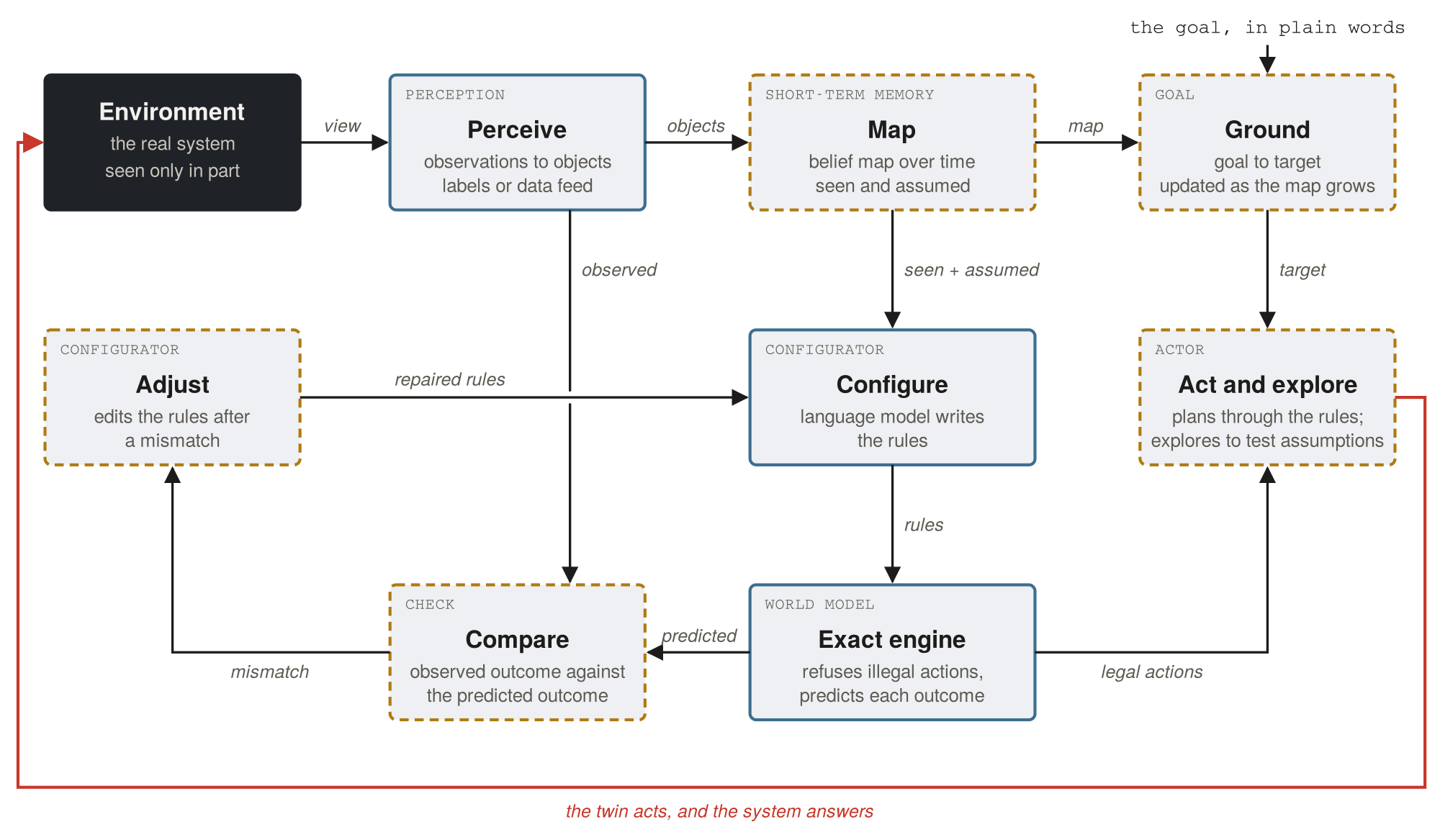
The Polytrion Open World Digital Twin architecture: the environment is perceived as objects, kept in a belief map of what is seen and assumed, a language model configures the rules, an exact engine predicts each outcome, the actor plans and explores, and a mismatch between prediction and outcome triggers the language model to repair the rules.
The architecture, with the module of LeCun’s blueprint that each step fills (upper-case labels). Configure, Ground and Adjust are language-model calls; the world model is a set of declared rules run by an exact engine.
ModuleLearned world models (JEPA)Polytrion
World modelA predictor learned in an embedding spaceDeclared rules, run by an exact engine
From perception to modelLearned from dataWritten in a grammar of objects, kinds and relations
Adapting to changeRetrainingA local repair of the rule that failed
What you can inspectWeightsEvery rule, every assumption, every prediction

Same blueprint as JEPA, a very different build.
An example

One surprise, and what the twin learns from it

The twin is shown one picture of a room with a closed door and told: “Walk to the second room.” No second room is in view, so it assumes one. Behind the door it finds a landing and a flight of stairs. It steps onto the stairs, expecting to stand on them, and finds itself on the floor below, in another place. Its prediction was wrong. It must write down what it learned.

A RULE FOR ONE OBJECT

“Stepping onto these stairs puts you at that spot on the floor below.”

True of the staircase that answered, and of nothing else. Move the stairs, or add a second flight, and the rule is wrong.

Fits what was seen. Fails everywhere else.

A RULE FOR THE KIND

“Stepping onto any stairs puts you beside the stairs they lead to, on the floor below.”

True of every staircase, in buildings the twin has never entered. The lesson is about stairs, not about one flight.

Holds where the twin has never been.

After one surprise, a language model tends to write the shortest rule it can, and the shortest rule names the one object that surprised it. Polytrion’s rule language is designed so the twin writes the second rule: the lesson about the kind, stated through the relation the surprise revealed. Every rule is then audited on layouts the twin never visited.

Where it applies

Perception is one module. The world can be abstract.

Nothing in the loop depends on vision. Wherever a model makes predictions that the world can contradict, the same loop applies: a missed forecast is the surprise, the repair is an edit to the model, and periods it was not repaired on play the role of unseen layouts.

Industrial plants

Equipment, flows and failure modes that drift from the original design.

Logistics networks

Routes, capacities and constraints seen only through shipments and delays.

Business models

Customers, channels and costs whose mechanisms are inferred, not given.

Economies

A declared model of the world economy on the same engine: 61 machines and 282 connections, each reacting to what the others publish. The world economy as an Open World Digital Twin →

Research

Declared before it ran. Audited where it never went.

Every experiment is declared before it runs, with its measures and expected results fixed in advance, and every rule the twin writes is audited on layouts it never saw.

First page of the Preprints.org article “A Declared World Model: Language Models Write the Rules of the Scene They are Shown” by Jean-Jacques Dubray, posted 13 October 2026.
Preprints.org Article

A declared world model: language models write the rules of the scene they are shown

From one fully visible scene, every model tested wrote correct rules; the paper measures when those rules hold beyond the scene.

world modelsdeclared world modelJEPAlarge language modelsprogram synthesisgeneralizationidentifiabilityscene graphs
Jean-Jacques Dubray · Cognitive Fab LLC Posted 13 October 2026 doi: 10.20944/preprints202610.1139.v1
Read it on Preprints.org ↗
PAPER 2 · SUBMITTED TO PREPRINTS.ORG

Terra Incognita: a declared world model that assumes what it cannot see and repairs its rules

The twin assumes a room it cannot see, acts on it and repairs its rules; the rule language decides whether what it learns generalises.

Preprints.org ID 238595, submitted 15 October 2026. The link will be added once it is posted.

The rule schemas, the checks applied to rules, the prompts and the engine are proprietary to Cognitive Fab and available for review under a non-disclosure agreement.

In Polytrion

One of two kinds of twin, on one engine

Polytrion offers Static Digital Twins, whose rules you declare and which replay exactly from four values, and Open World Digital Twins, described here, for systems that cannot be fully seen. It also ships a Monte Carlo simulator on a certified catalogue for the questions that need volume. All of it runs on the same engine, which was qualified against nine published answers in nine fields before it was allowed to answer anyone’s question.

Talk to us about an Open World Digital Twin

We are working with a small number of research labs and industrial teams on first proof-of-concept twins.

Contact Cognitive Fab →