Provable trust

Determinism is underrated

We are over-relying on stochastic reasoning, and paying for it in three currencies at once: precision, quality, and cost. Every time an agent re-derives a decision it has already made correctly a hundred times, it pays full inference price for a worse answer than a lookup would have given.

Worse, a step left to inference is a step you cannot check before it runs, cannot replay afterwards, and cannot explain to anyone who asks why.

The fix is not a larger model.

It is noticing how much of the work was never stochastic to begin with.

left to inference

The sequence an agent follows every Tuesday is a machine.

left to inference

A policy about what it may touch is a predicate.

left to inference

A rule mined out of your own history is an artifact you can score against a corpus before you adopt it, and re-score later when the corpus has moved.

In that setting, learning is replay, not retraining. The rule set complements the weights.

The stack

Augment reasoning, skills and memory with expertise, governance, workflows and simulation.

One agent, or a crew of them, doing the work of a business — with the deterministic parts pulled out of the model and into artifacts you can check, replay and explain.

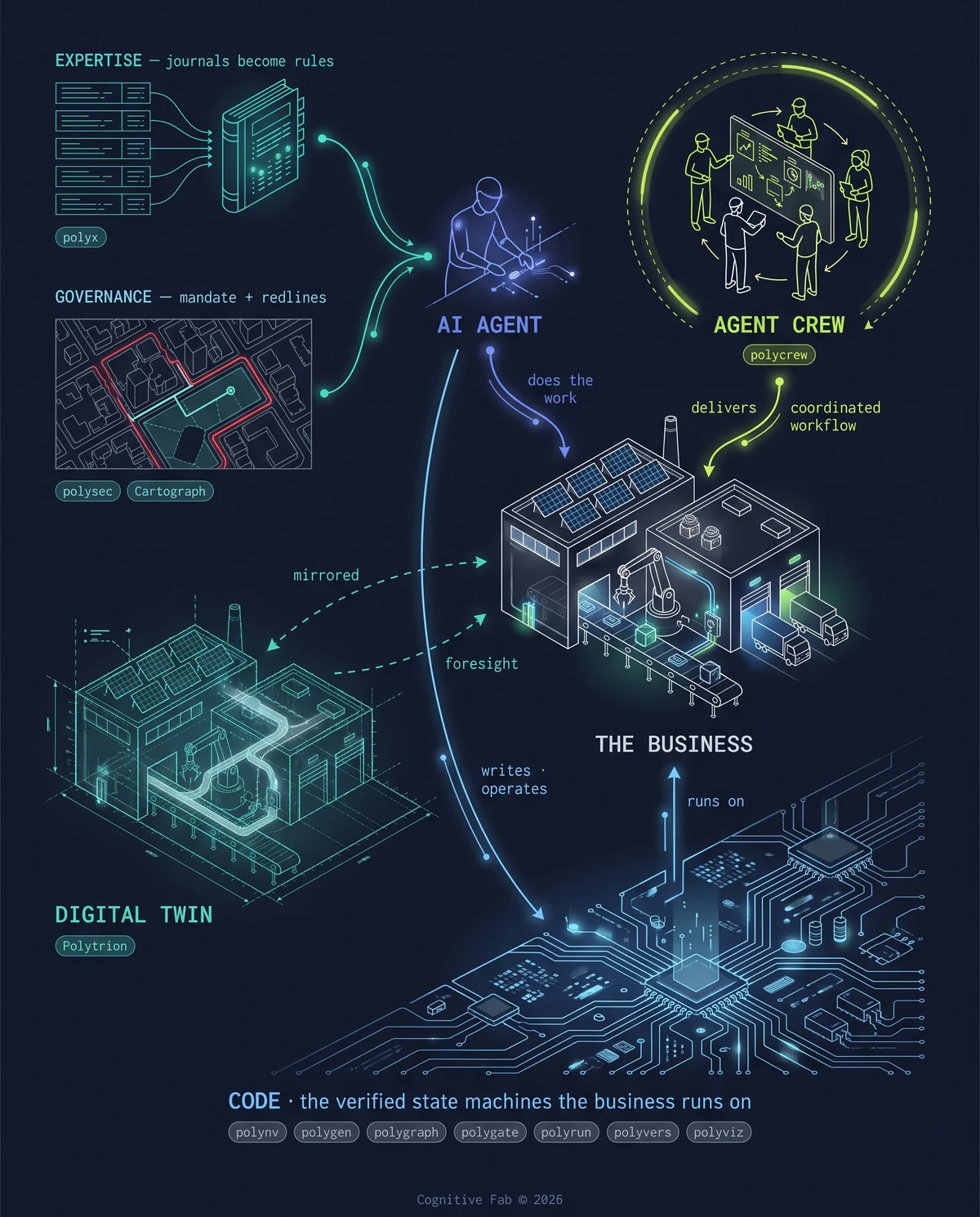
The Cognitive Fab stack. Expertise (polyx) turns journals into rules and governance (polysec, Cartograph) supplies a mandate and redlines; both feed the AI agent, which does the work of the business, writes and operates the code, and joins an agent crew (polycrew) that delivers a coordinated workflow. A digital twin (Polytrion) mirrors the business and returns foresight. Underneath everything sits code, the verified state machines the business runs on: polynv, polygen, polygraph, polygate, polyrun, polyvers, polyviz.
Expertise, governance, workflows and simulation over verified code — the four are deterministic forms, not add-ons. View full size ↗

Four deterministic forms

Those four are not new ideas dropped on top of an agent. Each one is the deterministic form of something the agent is already doing badly, at full price.

Underneath all four: code you can check before it loads.

Expertise, governance, workflows and simulation all come down to state machines — and the machines are the part an agent now writes faster than anyone can read. Polygraph explores every reachable state over declared domains and returns the shortest sequence that breaks a stated rule: a counterexample you can replay, not a hunch. No model sits on the decision path.

polynvpolygenpolygraphpolygatepolyrunpolyverspolyviz

Cognitive Fab is built on the belief that the deterministic share of an agent's work is far larger than we currently assume — and that pulling it out, into machines checked before they load and rules that carry their own evidence, is what turns an agent from something you hope about into something you can hold to its mandate.

Jean-Jacques Dubray, Ph.D. · author of the SAM pattern · the approach · Provable Trust, the blog

Work with us

Put the four pillars to work.

Advisory, training and hands-on builds from the author of the SAM pattern — not a menu, a map: pick a corner, or blend a path across it.

Partner with us Design Partner Program — co-develop the expertise, governance and simulation layer of your platform, with early access to the engines. selective

Tell me about your stateful code.

A 30-minute conversation about where AI-written code is quietly accumulating risk in your systems — and whether verification is the answer.