The price of thought is plunging. The price of trust is not on the chart.
Epoch AI measured how fast the price of an answer falls. We measured what it costs to know the answer is right, on the source code of three real systems. Study: 239 specifications, 35 planted bugs, $48.01.
3.4x to 10x
price per verified etcd Raft spec, over the price per spec
17 of 35
planted bugs that passed every machine check
0 accepted
in 151 model reviews of etcd Raft specs, including the 11 that passed every machine check
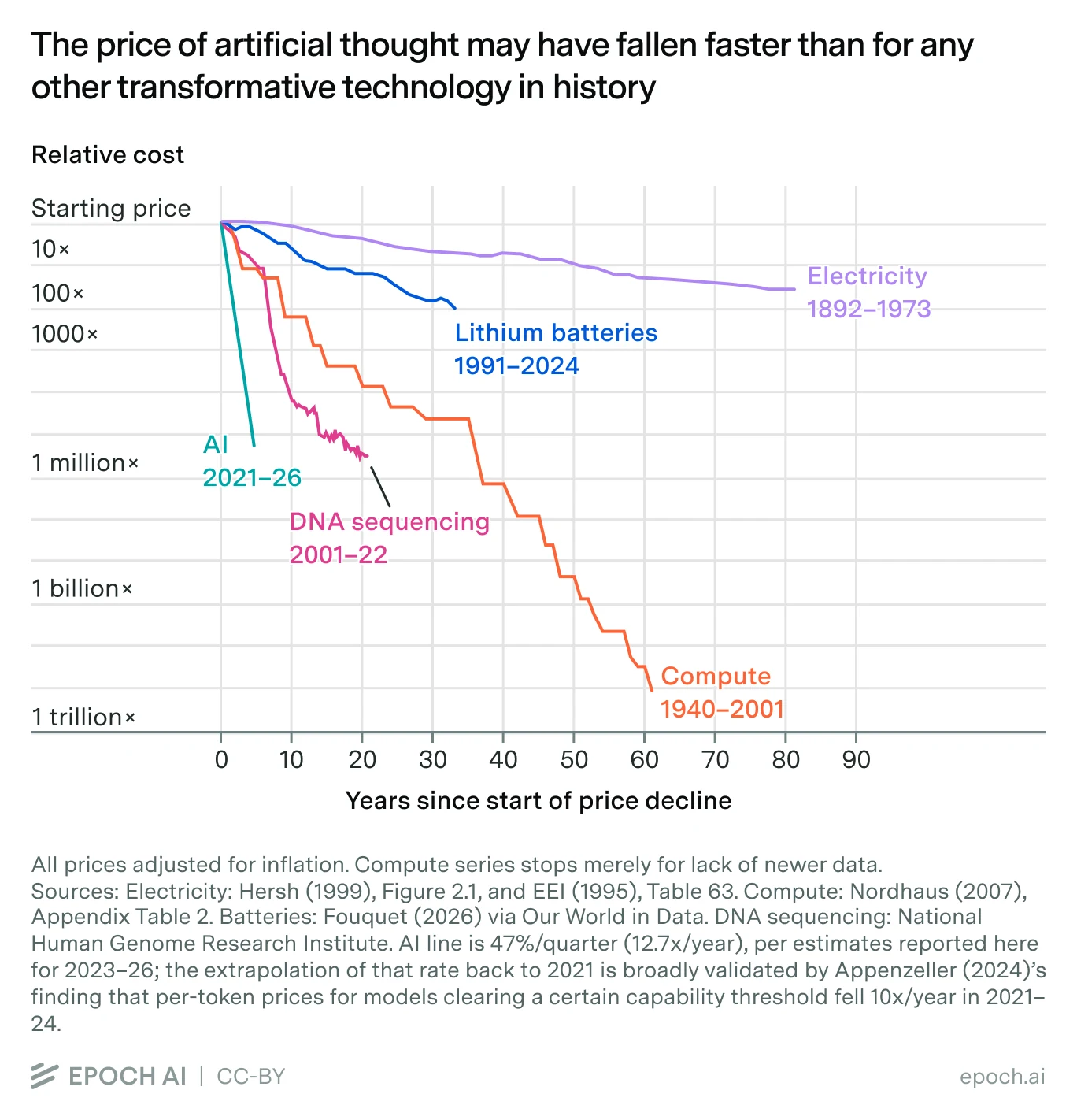
Epoch AI published "The Plunging Price of Thought" (Emberson and Roodman, September 22, 2026). The finding is striking: the cost of reaching a given benchmark score has fallen about 47% per quarter since 2023, roughly 13x per year. The method is careful. It prices the cheapest model that reaches each score, from math olympiad problems to PhD-level science questions.
Figure: Epoch AI, “The Plunging Price of Thought” (Emberson and Roodman, 2026), reproduced under CC-BY. Sources and notes are in the figure.
Every benchmark in that study ships with an answer key: the correct answer is stored with each question, so a script grades a response instantly and at no cost. Grading is free. The price it tracks is the price of producing an answer.
Work does not ship with an answer key. Before anyone uses an output, someone has to establish that it is correct. We ran a study to put a number on that second price.
Trust is becoming the work itself. Boris Cherny, who created Claude Code, recently used Opus 5.5 to formally verify the Claude Agent SDK in Lean: a couple of short prompts produced 16 pull requests fixing bugs and race conditions. He combines Lean with TLA+ to look at data flow, concurrency and state, and asks whether formal verification is the future of bug finding. That is trust produced by machines instead of human reviewers, and it is the kind of checking this study prices. It also carries a condition: a formal model finds real bugs only if the model is faithful to the code, so the model has to be verified too. Our task is that step. A model reads the source of a real system and writes an executable model of it. On etcd Raft, Opus 5.5 produced a model that passed every check 6 times in 20.
The study
We asked models to do a task where correctness can be decided mechanically: read the source code of a real system and write an executable specification of it. Three systems:
the Asterinas kernel spinlock (Rust)
the PGo distributed lock service (Go)
etcd Raft, raft.go v3.5.12 (Go), the consensus library behind etcd, the datastore of Kubernetes
The tasks come from our fork of SysMoBench (ICLR 2026). Each specification goes through four machine checks: it loads, a bounded exploration of its state space is clean, it reproduces every step recorded from the real system (28, 60 and 97 trace windows), and it never violates a safety invariant. A specification that passes all four is verified.
Four models wrote specifications: Claude Fable 5.1, Claude Opus 5.5, DeepSeek V4-Pro and DeepSeek V4.1-Flash, 20 samples per system at provider defaults. Every call was priced at list price. Machine checks were priced at AWS on-demand rates. Opus 5.5 and the two DeepSeek models then acted as reviewers: each read the task, the source and a specification, and answered ACCEPT or REJECT.
We also planted bugs. DeepSeek V4-Pro introduced one small behavioral bug into verified specifications (a weakened guard, a wrong comparison), 35 in all, and we asked whether the checker and the reviewers would catch them. Total spend: $48.01.
Price per answer and price per verified answer
On the two small systems every one of the 160 specifications was verified. The price per answer and the price per verified answer are the same: $0.07 to $0.08 for Fable 5.1, about $0.03 for Opus 5.5, $0.003 to $0.004 for V4-Pro and under $0.001 for V4.1-Flash.
etcd Raft is different.
etcd Raft
Per answer
All 97 steps reproduced
Verified
Per verified answer
Multiplier
Median time
Claude Fable 5.1
$0.977
9 of 19
4 of 19
$4.643
4.8x
168 s
Claude Opus 5.5
$0.219
19 of 20
6 of 20
$0.736
3.4x
32 s
DeepSeek V4-Pro
$0.140
3 of 20
2 of 20
$1.407
10.0x
591 s
DeepSeek V4.1-Flash
$0.028
6 of 20
3 of 20
$0.199
7.0x
182 s
etcd Raft: price per specification and per verified specification (USD)
Per answerPer verified answer
Per verified answer = (generation + machine check cost) / verified specs: the expected cost of sampling until one passes. 20 attempts per model (19 for Fable 5.1). Per answer counts every billed attempt.
The price per verified answer is the expected cost of sampling until one specification passes every check. On the hard system it is 3.4 to 10 times the price per answer, and the ranking changes. Per answer, DeepSeek V4-Pro is 36% cheaper than Opus 5.5. Per verified answer, it is almost twice as expensive. V4.1-Flash stays the cheapest, but its advantage over Opus 5.5 shrinks from 7.7x to 3.7x.
The chart can be misread. V4.1-Flash gives the cheapest verified specification, but it is not the better modeler. Opus 5.5 reproduced all 97 recorded steps in 19 of 20 specifications; V4.1-Flash did so in 6 of 20. Opus 5.5 also answered in a median of 32 seconds, against 182 seconds for V4.1-Flash, which writes about ten times as many tokens. With 20 samples each, the difference in full passes (6 against 3) is not statistically significant (Fisher's exact test, p ≈ 0.45). V4.1-Flash is cheapest per verified answer for one reason: each attempt costs an eighth as much, and an automatic checker discards the 17 failures at almost no cost. Without a checker, a single V4.1-Flash specification has an 85% chance of being wrong, and a person has to find out which. A cheap model with a checker beats an expensive model alone. With no checker, the expensive model is the better choice.
etcd Raft, 20 attempts each
Claude Opus 5.5
DeepSeek V4.1-Flash
Price per specification
$0.219
$0.028
Output tokens per specification
3,541
39,524
Median time per specification
32 s
182 s
Load and explore cleanly
19 of 20
19 of 20
Reproduce all 97 recorded steps
19 of 20
6 of 20
Keep every safety invariant
6 of 20
11 of 20
Pass all four checks (verified)
6 of 20
3 of 20
Chance a single specification is wrong
70%
85%
Price per verified specification, with a checker
$0.736
$0.199
Accepted by a model reviewer
0
0
Spinlock and lock service, verified
40 of 40
40 of 40
Neither model dominates. Opus 5.5 copies the recorded behavior of etcd far more faithfully; V4.1-Flash keeps the safety invariants more often but diverges from what the real system did. Each fails a different check, which is another reason to run all of them. Highlighted cells mark the better value in each row; the difference in verified specifications is not statistically significant.
Price per answer also hides how the money is spent. Opus 5.5 writes about 3,500 output tokens per etcd specification. Both DeepSeek models write about 39,000, most of it reasoning.
The models fail differently too. 19 of 20 Opus 5.5 specifications reproduce all 97 recorded steps; 13 of them then violate a safety invariant when the state space is explored. 17 of 20 V4-Pro specifications fail on the recorded steps themselves. A single check would have told different stories.
Claude Fable 5.1, the most expensive model in the study, passed the machine checks most often when it answered: 4 of the 9 specifications it completed were verified, and all 9 reproduced every recorded step. But Fable 5.1 often did not finish. On 10 of its 19 attempts, Anthropic's API stopped the answer partway through and returned a refusal stop reason instead of a complete specification. We do not know why; the task is ordinary systems code. Each stopped attempt was still billed for the tokens generated before the stop ($0.39 to $2.06), so 44% of Fable's etcd spend bought nothing usable. A buyer pays for those attempts too, so they count: 19 paid attempts produced 4 verified specifications, $4.64 each, 6.3 times Opus 5.5. Counting only the finished attempts would give about $2.60.
The cost of checking
Once the checker exists, running it is almost free. A check takes about 1.3 seconds on the small systems and up to about one minute on etcd. At cloud prices that is $0.00003 and $0.0006 to $0.0016. On etcd it is 0.75% of what Opus 5.5 spends writing the specification.
A model reviewer is not free. An Opus 5.5 review of an etcd specification costs $0.175, 80% of what it cost Opus 5.5 to write it. The reviewer reads the same 37,000-token task, source included, and reasons about it. A V4-Pro review costs $0.031 and a V4.1-Flash review $0.010.
What the checker misses
The checker missed 17 of the 35 planted bugs: 12 of 13 on the spinlock, 5 of 15 on the lock service, 0 of 7 on etcd. A typical escape lets a thread release a lock it does not hold. The recorded traces never contain that step, the invariants still hold, and the bug passes every check.
Planted bugs by system: caught or missed by the machine checks
Caught by the checkerMissed by the checker
Labels read caught / missed. Every reviewer rejected every missed bug it saw: 17 of 17 for both DeepSeek models, 14 of 14 for Opus 5.5.
Every reviewer rejected every missed bug it reviewed: 17 of 17 for both DeepSeek models, 14 of 14 for Opus 5.5. They also rejected every bug the checker caught, and accepted all 120 correct specifications of the small systems they were shown, with no false rejection. On small systems the reviewer and the checker are complementary, and a reviewer costing a tenth of a cent did as well as one costing 2 to 3 cents.
"Verified" means consistent with what was recorded and with the invariants someone wrote down. It does not mean correct.
What the reviewer rejects
On etcd the reviewers accepted nothing: 0 of 151 reviews, including every review of the 11 specifications that passed all four machine checks. Their reasons are specific and checkable.
HandleVoteRequest counts a candidate as up to date whenever its index is at least the node's log length, ignoring logTerm, which contradicts raft.go's isUpToDate.Opus 5.5 review of a verified etcd specification
The reviewers hold the specification to the source code. The checker holds it to the recorded behavior. On etcd the two references disagree, partly because the task's observable state records only the length of each log, so an exact vote rule cannot be written. Neither verdict is ground truth. An organization that requires both a passing checker and an accepting reviewer ships nothing on this task, at any price.
Limitations
One task family (specifications of concurrent systems) and four models.
20 samples per cell (19 for Fable 5.1 on etcd, cut short by an API usage limit); pass rates are coarse and no significance test is claimed.
Content-filter stops count as failed attempts at their billed cost. No reviewer saw the Fable 5.1 specifications.
The cost of building the checker (instrumenting the systems, capturing traces, writing invariants) is not measured. It is the fixed cost behind the near-zero running cost, and token prices do not reduce it.
The planted bugs were written by a model, and the reviewer prompt asked for faithfulness to the source, which is stricter than the trace contract.
The Opus 5.5 reviewer did not see the DeepSeek V4-Pro etcd specifications or three of the planted bugs, and the V4-Pro reviewer did not finish the last five V4-Pro etcd specifications.
API calls that failed during a network outage on our side were retried and are excluded from the prices.
The study author designed the task contract (the lean executable-specification format used here).
Conclusion
The Epoch study measures the price of an answer. On an easy task that is also the price of a trusted answer. On a hard task it is not. A verified etcd specification costs 3.4 to 10 times an unverified one, the cheapest model per answer is not the cheapest per verified answer, the cheapest per verified answer is cheapest only when an automatic checker exists, the most capable model spent 44% of its budget on answers the API stopped before delivery, and a specification that satisfies both the machine checker and a model reviewer could not be bought at all. Running a checker costs almost nothing; building one is the expensive part, and it only covers what was recorded. A model reviewer covers what the checker does not, at a price that can approach the price of generation.
Answers are getting cheap fast. The metric to watch is the price per verified answer, together with a statement of what "verified" checked.
Prices: Anthropic and DeepSeek list prices and AWS c7i on-demand rates, September 23, 2026.