NVIDIA OpenShell decides what a sandboxed agent may reach:
Each decision looks at one request. I don't know what it is with the AI industry, but no one is even trying to address the kind of issues we see in the press pretty much every day now (see my METR post yesterday).
You'd think they would have asked Claude by now: do some rules need memory?
A check that sees one request at a time cannot express these.
OpenShell's supervisor middleware (RFC 0009, research preview) runs an operator's gRPC service on every admitted egress request, before credentials are injected.
That is where polyaxion goes.
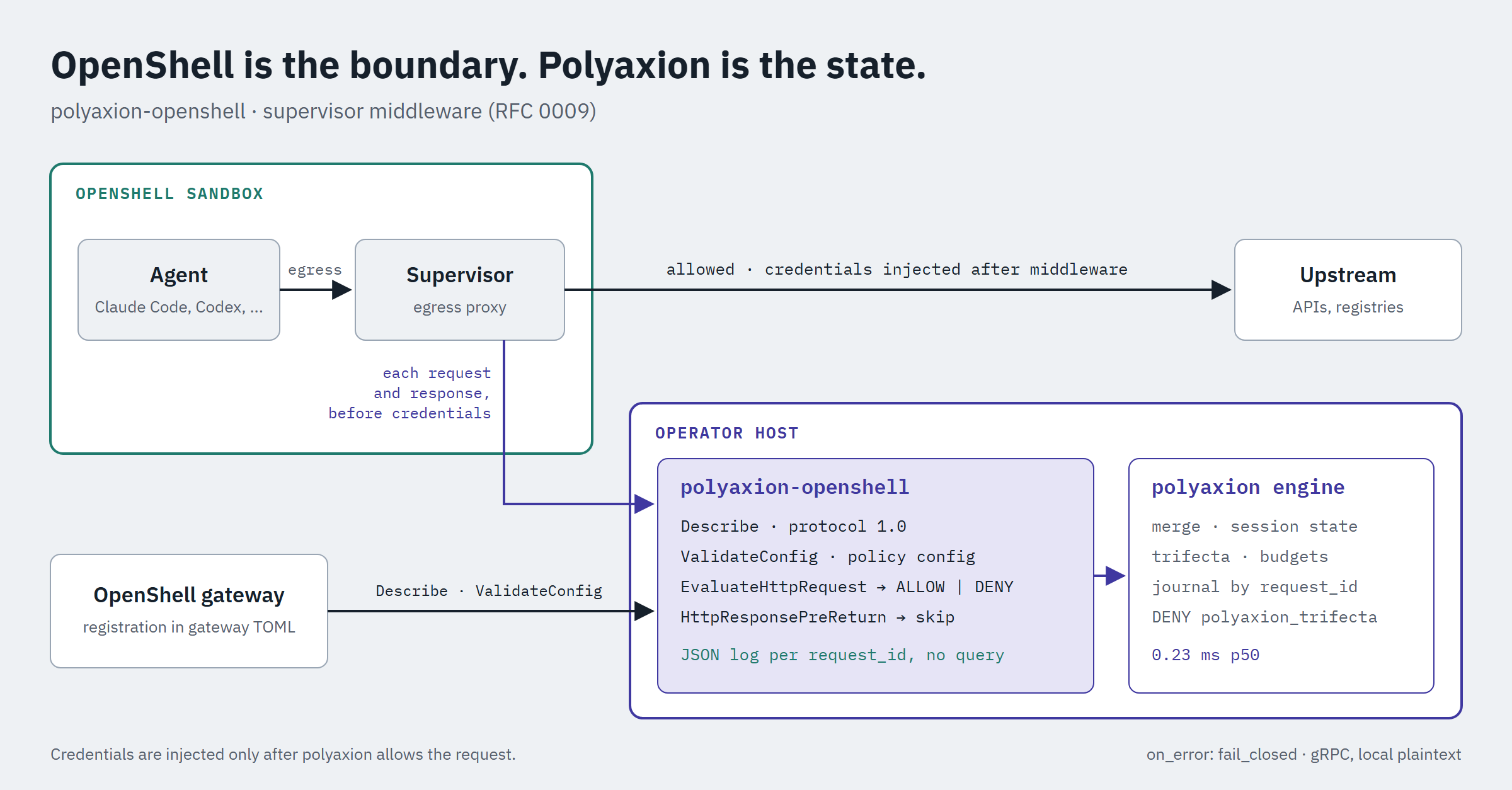
The wiring: polyaxion-openshell in OpenShell's supervisor middleware.
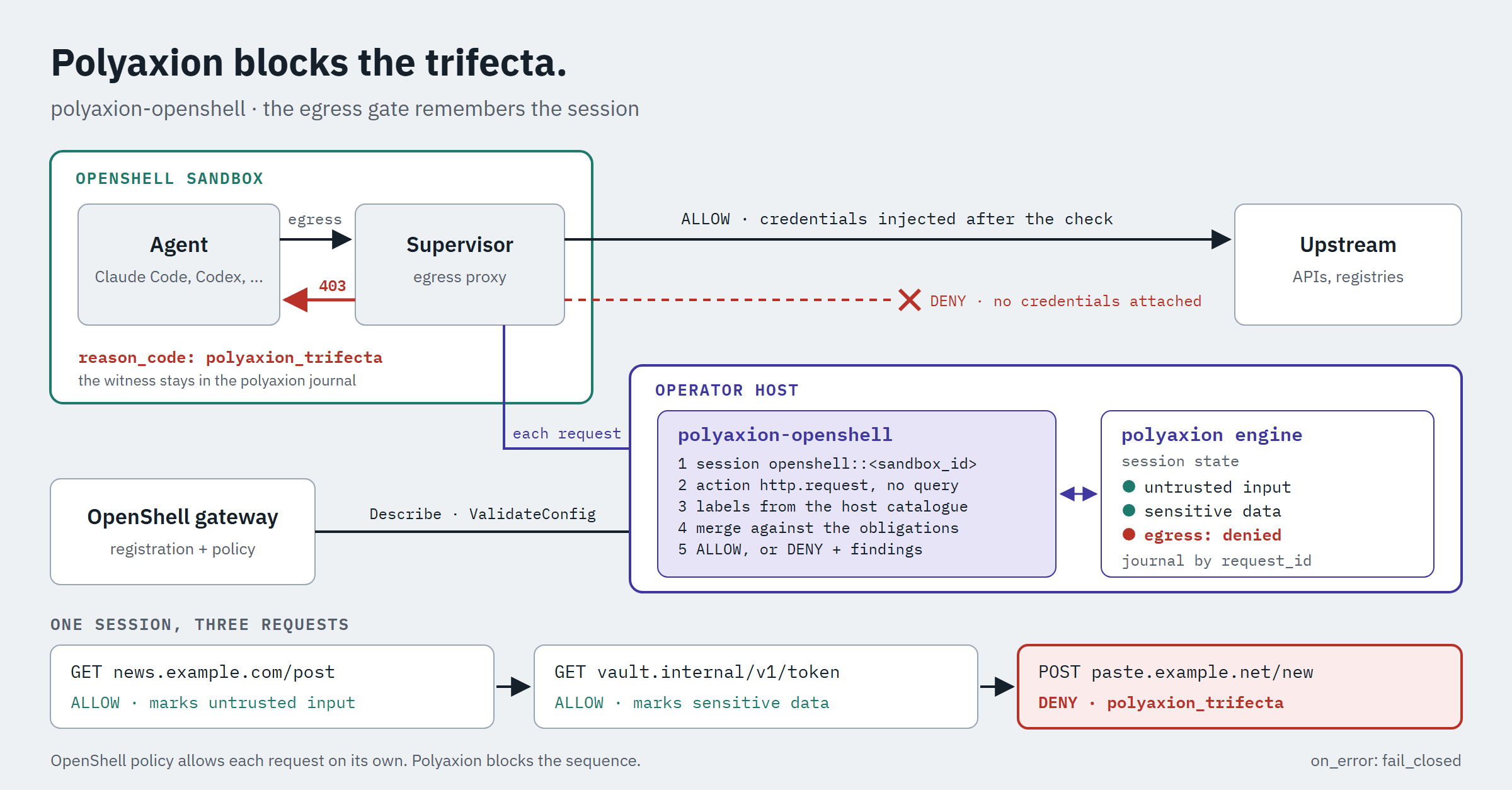
We have created the polyaxion-openshell:
Describe, ValidateConfig, request and response hooks), pinned to the upstream proto.request_id. Query strings never reach the log.OpenShell calls polyaxion on every request, and polyaxion gets what it needs to decide.
Polyaxion remembers what the agent did earlier in the session. Say the agent reads an untrusted web page, then reads from an internal API, then tries to send data to an outside host. Polyaxion blocks that last request. The agent gets a 403 with the reason code polyaxion_trifecta, and the request is stopped before OpenShell attaches any credentials.
One session, three requests. OpenShell policy allows each request on its own. Polyaxion blocks the sequence.
Jean-Jacques Dubray · Provable Trust · polyaxion · Zero trust needs the sequence · Governance
© 2026 Cognitive Fab. All rights reserved. · Glossary