We are over-relying on stochastic reasoning, and paying for it in three currencies at once: precision, quality, and cost. Every time an agent re-derives a decision it has already made correctly a hundred times, it pays full inference price for a worse answer than a lookup would have given.
Worse, a step left to inference is a step you cannot check before it runs, cannot replay afterwards, and cannot explain to anyone who asks why.
It is noticing how much of the work was never stochastic to begin with.
The sequence an agent follows every Tuesday is a machine.
A policy about what it may touch is a predicate.
A rule mined out of your own history is an artifact you can score against a corpus before you adopt it, and re-score later when the corpus has moved.
In that setting, learning is replay, not retraining. The rule set complements the weights.
One agent, or a crew of them, doing the work of a business — with the deterministic parts pulled out of the model and into artifacts you can check, replay and explain.
Those four are not new ideas dropped on top of an agent. Each one is the deterministic form of something the agent is already doing badly, at full price.
A rule that has held across your last two hundred runs is a lookup, not an inference. Mine it out of your own history, have a person approve it, and serve it to the agent before it acts. Ships with a Claude Code hook.
What an agent may touch is a predicate over a policy — checkable before the agent starts rather than regrettable after. Either every path to your secrets crosses a gate, or here is the concrete path that doesn't.
An agent that rebuilds its own to-do list every run will rebuild it differently every run. A workflow is that plan as a machine, admitted only if every path through it passes — and a crew shares one run without doing anything twice.
Explore what a decision does against a virtual clock, across a fleet, before it reaches anything real. Every result replays exactly from engine version, scenario, seed and replication index.
Expertise, governance, workflows and simulation all come down to state machines — and the machines are the part an agent now writes faster than anyone can read. Polygraph explores every reachable state over declared domains and returns the shortest sequence that breaks a stated rule: a counterexample you can replay, not a hunch. No model sits on the decision path.
Each product takes one kind of repeated decision out of inference. The domains on the right are where those decisions carry the most weight. Hover a product to trace it.
Fig. 1 — The four deterministic forms and the code layer beneath them (left), and the domains they serve (right). A band means the product addresses a decision that domain makes over and over.
AI will change who delivers the outcomes your customers pay for. A horizon diagram puts that outcome at the center, and around it every AI building block and regulation that will act on its steps. Each block is a decision you have not made yet.
The lifecycle of the outcome customers rely on you for. Customers do not buy products; they buy outcomes.
The AI building blocks, live or proposed, each wired to the step it acts on. Regulations sit on the ring too: a rule can make a block core, or set the date by which you must choose.
It rarely attacks the step you are best at. It sits next to the customer and takes over the final outcome.
Every block is a decision you have not made yet, and a second question: is it ready now, or when will it be?
The final outcome goes to whoever the customer trusts to deliver it, and a customer delegates an outcome to an agent only on two counts: precision, so it can rely on the result, and safety, so no one can turn the agent against it. Both have to be shown to customers, auditors and regulators — which is where the four deterministic forms come in.
Customers never wanted a bank. They want their money managed: paid, saved and grown at the right moment. The threat is not the fintech app; it is the customer's own finance agent, moving money across banks on the customer's behalf.
Fig. 2 — A bank's horizon, simplified from the banking case in five horizons. The lifecycle at the center is the outcome customers rely on the bank for; the ring holds the AI building blocks that act on each step. The block that matters most is the one positioned to take over the final step.
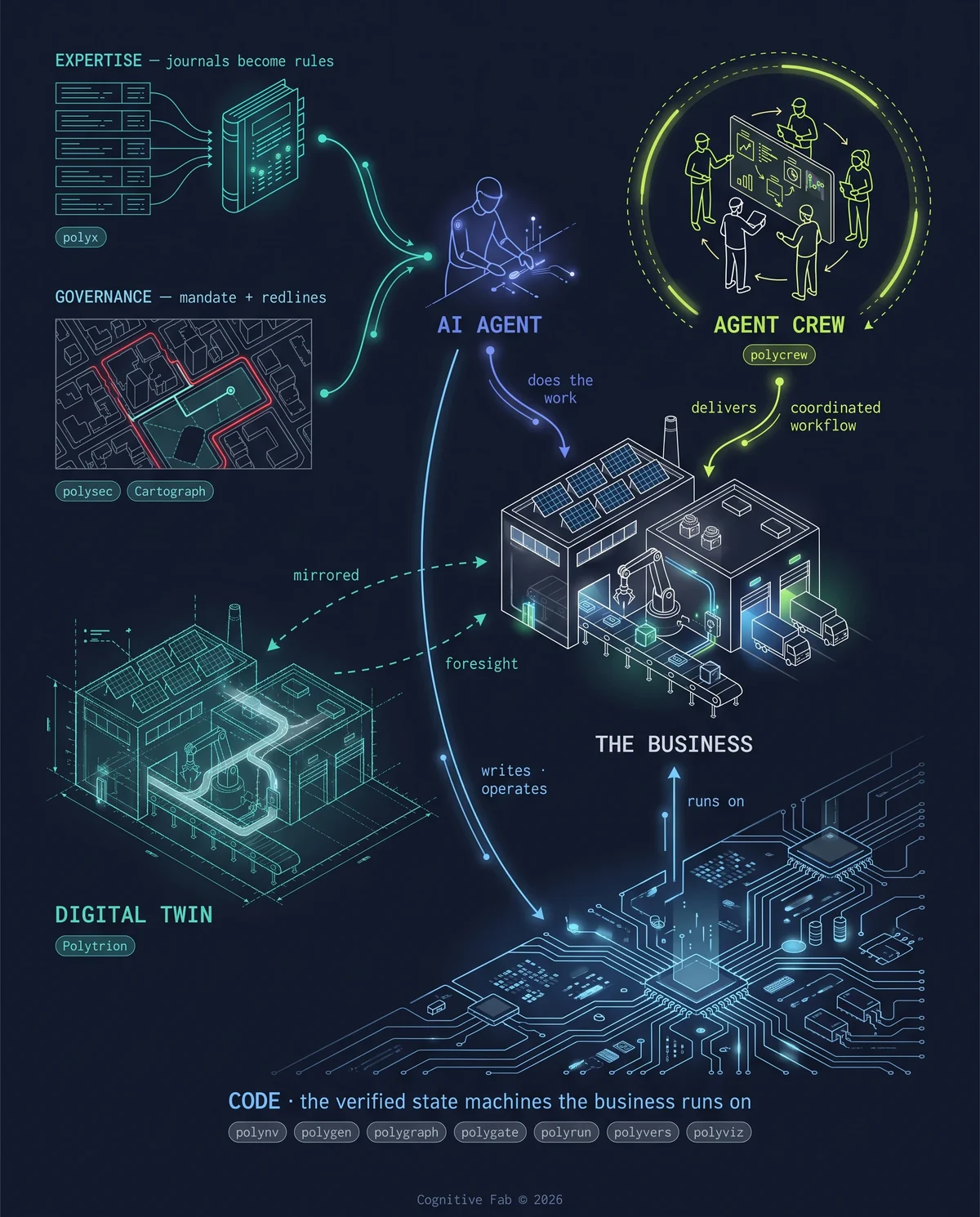
Cognitive Fab is built on the belief that the deterministic share of an agent's work is far larger than we currently assume — and that pulling it out, into machines checked before they load and rules that carry their own evidence, is what turns an agent from something you hope about into something you can hold to its mandate.
Jean-Jacques Dubray, Ph.D. · author of the SAM pattern · the approach · Provable Trust, the blog
Advisory, training and hands-on builds from the author of the SAM pattern — not a menu, a map: pick a corner, or blend a path across it.
Expertise, governance, workflows and simulation — installed hands-on, on your own code and systems, not toy examples.
half-day to two-day · remote or on-site 04 · BUILDWe build it in your stack, with your team — rules mined, policies proven, workflows admitted, twins running.
scoped build · your stack 01 · ASSESSWhere your systems and agents lean on inference today — and what to pull into rules, workflows and policy first.
fixed scope · written assessment + roadmap 03 · EMBEDThe four pillars embedded in your lifecycle, with your hardest machines and policies reviewed on call.
monthly retainer · continuousA 30-minute conversation about where AI-written code is quietly accumulating risk in your systems — and whether verification is the answer.